$108.90
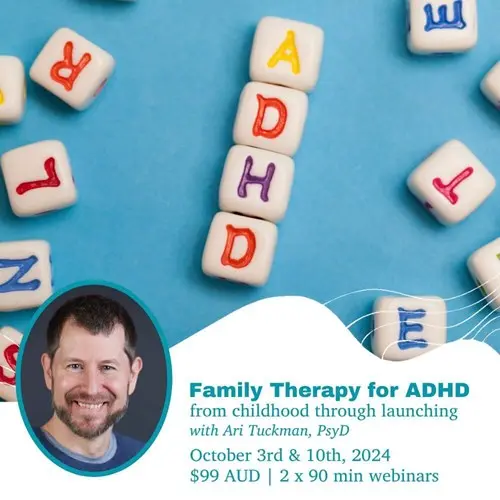
This online course is designed for clinicians to learn evidence-based family therapy strategies that address the unique challenges families face when supporting children, teens, and young adults with ADHD. It covers how executive function deficits impact daily functioning, reduces family conflict, and equips practitioners with tools to support clients from early childhood through launching into adulthood.
This professional development training is ideal for mental health professionals such as psychologists, counsellors, therapists, social workers, and other clinicians who work with ADHD-affected families and want practical strategies to improve family dynamics and outcomes.
After completing the course, participants will be able to:
Explain how ADHD affects functioning and family dynamics.
Apply strategies to help families negotiate common stress points like homework, mornings, and screentime.
Support parents and college-bound young adults in navigating expectations and independence.
Yes – the course offers flexible online access so clinicians can complete the modules on their own schedule. Access to the course is provided for a defined period upon enrolment, giving learners time to revisit sessions and consolidate skills.
The course covers:
ADHD and executive function challenges
Family therapy goals and frameworks
Practical strategies for daily routines and behaviour change
Transition planning from adolescence to adulthood
Medication considerations and family dynamics
Strategies for launching young adults into higher education or careers.
Family therapy can improve communication, reduce conflict, and teach evidence-based strategies to manage executive function challenges. It helps families collaboratively address routines like homework and mornings, balance independence with support, and foster understanding of ADHD within the family system.
Yes. A major focus of the training is helping clinicians guide families through the “launching” stage, which includes preparing teens and young adults with ADHD for college, work, and independent living, including negotiating roles, expectations, and long-term success strategies.
Unlike basic ADHD education, this course integrates family therapy frameworks and practical, clinician-focused strategies to reduce conflict, improve daily functioning, and guide families through developmental transitions from early childhood to adulthood.